
Ressources pour les coordinateurs de soutien et les gestionnaires de cas
Included below are some tools for Support Coordinators and Case Managers as they support people in the Settlement Agreement population accessing their own rental housing in the community.
If you are assisting an eligible individual and need technical assistance, please feel free to contact the DBHDS Housing Specialist in your area at housingreferrals@dbhds.virginia.gov.

Faire une demande de logement
Support coordinators who make referrals for DBHDS housing resources must complete the Housing Referral Form. The Housing Action Plan is a tool that may be used to assist and guide successful preparation for independent housing planning.
If a referred individual already leases their own housing, include the Housing Financial Needs Form. Submit all documents by secure email to housingreferrals@dbhds.virginia.gov. DBHDS will not accept illegible forms.
Informer les individus sur les possibilités de logement intégré et indépendant
Documents
Évaluation du logement et planification centrée sur la personne
Tutelle, bail et recherche de logement
Aides familiaux résidants
Recherche de colocataires
State Rental Assistance Program Support Coordinator Checklist
The Support Coordinator/Case Manager checklist enumerates the tasks support coordinators/case managers should complete with individuals to ensure they are prepared to use housing resources (e.g., housing choice vouchers, SRAP, etc.) in a timely manner; if they are referred. Submission of a referral occurs after a variety of tasks have been accomplished. This is important as performing these steps first increases the likelihood a person will be prepared to use the housing resource and decreases the chances a person will be determined ineligible or decline the housing resource after it is offered. If you need assistance with helping someone transition, please contact the DBHDS housing specialist for your region.
Foire aux questions
Prior to completing the referral form, please download and review the Frequently Asked Questions (FAQ) document.
Chèque de choix du logement
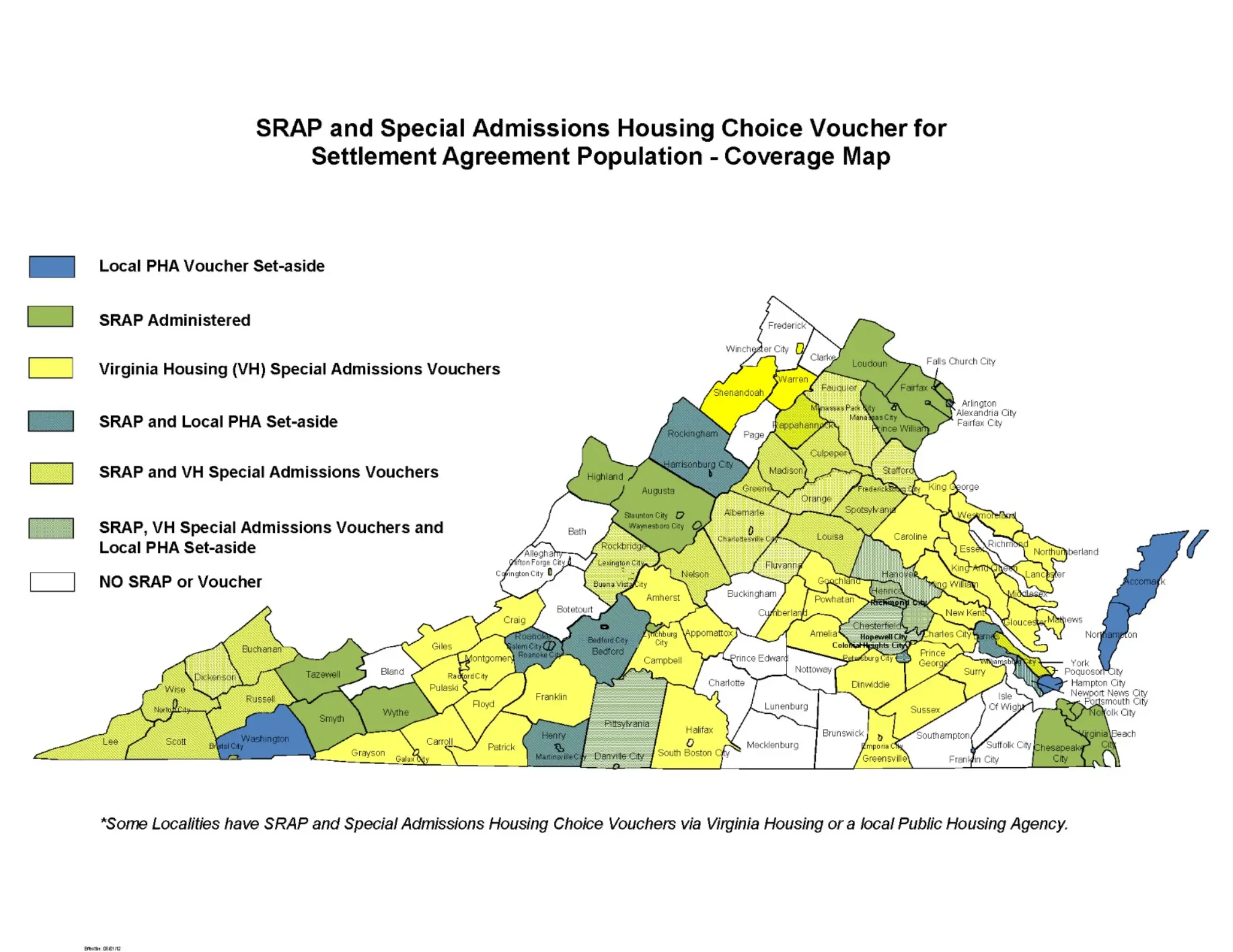
Préférence en matière d'admission aux bons de logement pour la population visée par l'accord de règlement
DBHDS continues to accept referrals from DD Support Coordinators and Private Case Managers for individuals in the target population that would like to live in their own rental housing with appropriate supports.
DBHDS maintains a referral list for housing choice vouchers and eligible individuals are moved up on the list as referrals are made to Virginia Housing Development Authority (VHDA) and other local housing choice voucher programs. If an individual’s name comes to the top of the list and they decides not to utilize the voucher, their name will be removed from the referral list and a new referral must be submitted in order for the individual’s name to be placed back on the list.
Referrals should only be made for individuals who have:
1) made an informed decision to live in their own rental housing;
2) are ready or can be ready to move within 120 days of being referred and/or approved for a voucher and
3) who have or will have adequate waiver, non-waiver and natural supports in place needed to attain and maintain their housing in the community.
Low-Income Housing Tax Credit (LIHTC)
Some rental properties in Virginia that are financed with Low-Income Housing Tax Credits (LIHTC) have been made affordable apartments available with a leasing preference to people with developmental disabilities (DD) in the Settlement Agreement population* and/or people with serious mental illness who are approved for DBHDS permanent supportive housing (the “Target Population”). A leasing preference gives these individuals an opportunity to lease units at the property before these units are made available to other applicants. DBHDS can place a “hold” on a unit while an individual (1) obtains rental assistance to help the individual financially qualify to rent the unit and (2) gathers the documentation needed to submit a rental application. Individuals must have rental assistance to receive a leasing preference.
DBHDS distributes a statewide Housing Alert twice weekly to CSB DD support coordination and PSH case management staff. The Housing Alert lists LIHTC properties that have units available with a leasing preference. DD Support Coordinators and PSH case management staff can search the Alert to identify an appropriate apartment property and request a hold on a unit for an individual in the Target Population by contacting lihtc@dbhds.virginia.gov. Include the property name in the subject line of the email. The LIHTC Coordinator will verify the individual’s eligibility for a leasing preference and have the referring staff submit a LIHTC Unit Hold Request form.

Permanent Supportive Housing (PSH) for Persons with Serious Mental Illness (SMI)
The Commonwealth of Virginia is committed to providing supportive housing opportunities for adults with serious mental illness (SMI) to promote wellness, prevent and end experiences of homelessness, avoid unnecessary hospital admissions, and facilitate discharges from institutional facilities in compliance with the Americans with Disabilities Act (ADA), as interpreted by the Olmstead decision.
DBHDS PSH programming builds works to provide and coordinate community-based behavioral and primary health care services to individuals with SMI in stable rental housing of their own. PSH enables individuals to have coordinated access to services that help ensure successful tenancy, reduce the impact of mental illness symptoms and medical problems, and promote choice and community integration.
Community Services Boards (CSBS) operate DBHDS PSH programs using a scattered-site PSH model with state funds largely providing long-term rental assistance and supportive services such as housing stabilization, case management, and peer support services.
Programs must prioritize PSH for individuals leaving state hospital while also working in close collaboration with their local homeless Continuum of Care (CoC) or Local Planning Group (LPG) to ensure coordinated prioritization of vulnerable individuals with SMI who are experiencing homelessness.
PSH programs must adhere to housing first principles, meaning that housing is prioritized for individuals with significant needs, barriers to accessing housing are minimized, and housing is maintained regardless of compliance with clinical services. CSBs and other community partners provide an array of clinical and case management services through their existing service portfolios. These services must be highly coordinated with PSH services to ensure that the priority populations are effectively served.
DBHDS PSH programs for adults with serious mental illness must only enroll households meeting HUD’s standards for very low income (50% Area Median Income or below) that also meet one or more of the following criteria:
1) Patients in state psychiatric facilities,
2) Residents of supervised residential settings (e.g., ALFs, group homes) who want to live more independently,
3) Individuals chronically homeless (as defined by HUD) or literally homeless and at risk of becoming chronically homeless,* and/or
4) Individuals who are unstably housed and frequent users of hospital or criminal justice system interventions.*
*Programs must establish local, objective prioritization criteria that promote access to PSH by those with significant risk factors. Prioritization criteria must be approved by DBHDS.
Permanent Supportive Housing (PSH) for Pregnant or Parenting Women (PPW) with Substance Use Disorders (SUDs)
Pregnant and parenting women (PPW) who use substances have multiple, complex behavioral health, medical, and social support needs which impact their health and well-being and that of their children. They too often live in conditions that do not support their recovery. For women with children, housing represents more than just shelter. Stable housing is a crucial support for recovery, represents safety for both women and their children, and helps families successfully integrate into their communities.
Eligibility Criteria to Participate in the PSH for PPW Program
Household composition must include a pregnant or parenting woman, including families working towards reunification, with at least one minor child. The eligible woman must meet current clinical criteria for a Substance Use Disorder (SUD) and present with additional risk factors such as child welfare involvement, homelessness or housing instability with high utilization of criminal justice, inpatient or residential treatment, domestic violence, and/or crisis or emergency services. Households must also meet HUD’s standard for very low income (50% Area Median Income or below).
Current Programs
There are currently six PSH PPW programs throughout the Commonwealth that are operated by Hampton-Newport News CSB (25 slots), Richmond Behavioral Health Authority (25 slots), Northwestern CSB (20 slots), Blue Ridge Behavioral Healthcare (25 slots), Henrico Mental Health (15 slots) and Mount Rogers CSB (20 slots). At full utilization, over 130 households will be served and supported by PSH PPW programs.